
The role of automation and control software in next-generation cryogenic systems for quantum computing
Automation, digital twins and intelligent control for cryogenic quantum systems.
Cryogenics is becoming a cyber-physical system
A traditional cryogenic installation is organised around monitoring. Sensors report temperature, pressure, flow and vibration; a control system built on PLC, EPICS or LabVIEW collects them; and an operator watches, waits for an alarm and acts.
A dilution refrigerator running a quantum processor no longer fits that model. Temperature, pressure and flow are coupled to compressors, pumps and valves, and to the RF readout of the processor itself. The result is hundreds of coupled parameters, many operating states and long failure chains.
We are no longer monitoring a refrigerator. We are operating a cyber-physical system.
A physical disturbance becomes a computational problem
Disturbances in the cryostat reach the qubits along two paths. On the thermal path, a temperature drift raises the thermal population, which increases qubit error and lowers fidelity. At millikelvin temperatures, a rise of about 10 mK can roughly double the thermal population, with potential T₁ and coherence degradation.
On the mechanical path, a compressor or flow anomaly changes cooling performance and disturbs the cryogenic environment, reducing coherence and destabilising the qubit. Small vibration-induced frequency fluctuations accumulate as phase noise and directly shorten T₂*.
The question is no longer “Is the fridge OK?” It becomes “Is the environment fit for reliable quantum computation?”
If the problem is system-level, control must be system-level
Our approach puts one software layer across the whole cryogenic stack, connecting observability, automation and closed-loop control. The layer spans the pulse-tube compressor, the gas handling system, Lake Shore thermometry, vacuum and leak monitoring, RF readout through VNA and DMM, and superconducting R(T) measurements.
Pulse-tube compressor health and early warning
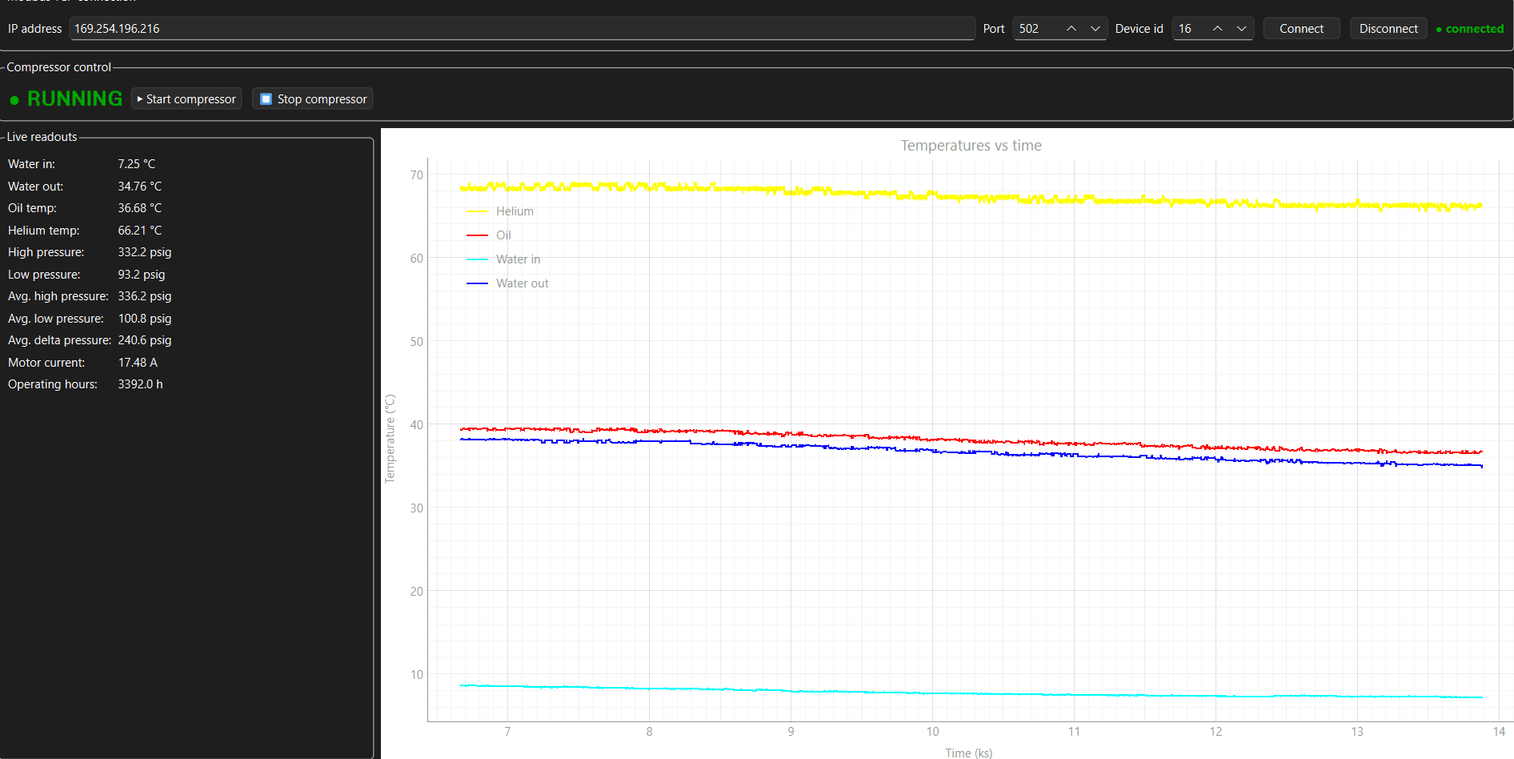
The software starts, stops and monitors the compressor, and records a live health signature: helium high, low and differential pressure, cooling-water inlet and outlet temperature, oil temperature, motor current and run hours. Logging is built to survive power and network drops and resumes automatically.
A developing failure rarely shows up in a single reading. It hides in the relationships between sensors, which leads to the question this work is built around: can we detect degradation before failure?
Gas handling system
The gas handling system manages the ³He / ⁴He mixture through condensing, circulation, storage and recovery. Software monitors and logs line pressures, circulation flow and the state of every pump and valve, and sequences valves, pumps and interlocks. Continuous logging and state tracking make safe, unattended operation possible.
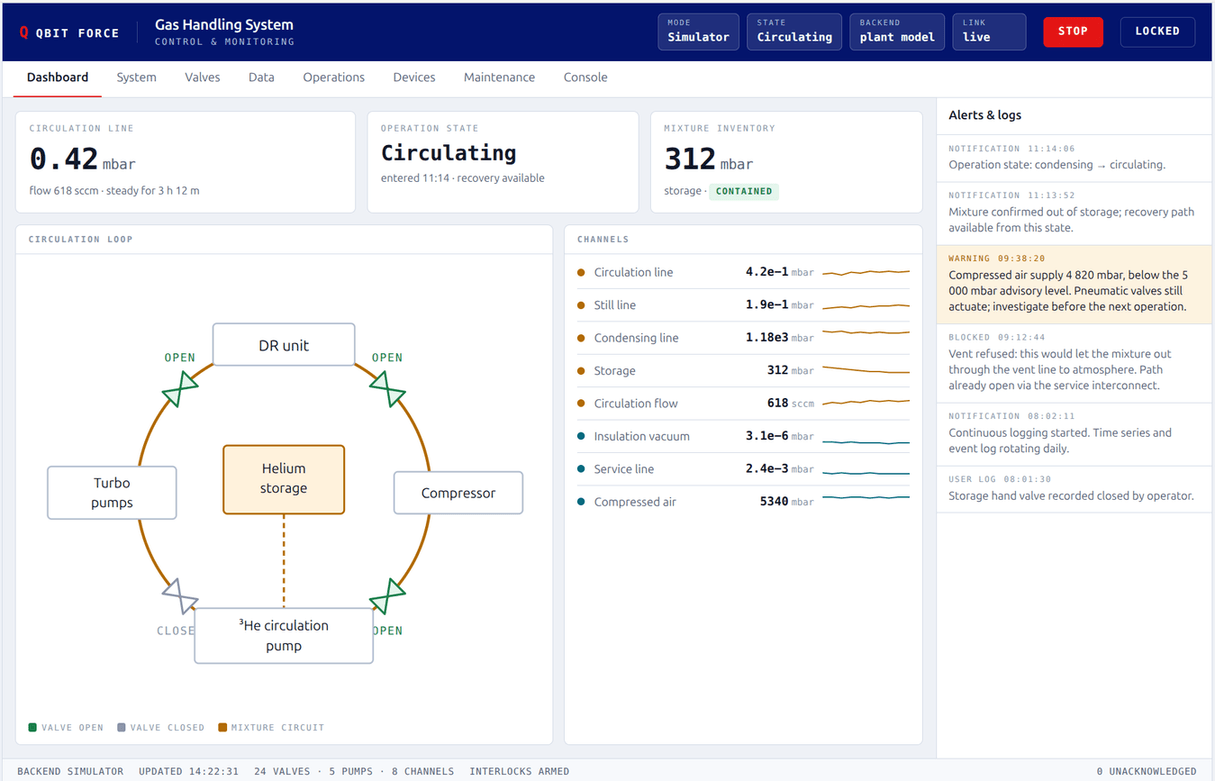
The question here is whether complex sequences can be automated safely and repeatably.
Thermometry and control with the Lake Shore 372
- An AC resistance bridge reads sensors across the stages.
- Resistance is converted to temperature through calibration curves, at low excitation to avoid self-heating.
- A closed loop combines live readout with setpoint and heater control.
- Real cooldown data, from 293 K to about 4 K across multiple stages, feeds model-based state estimation and, in future, physics-informed thermal modelling.
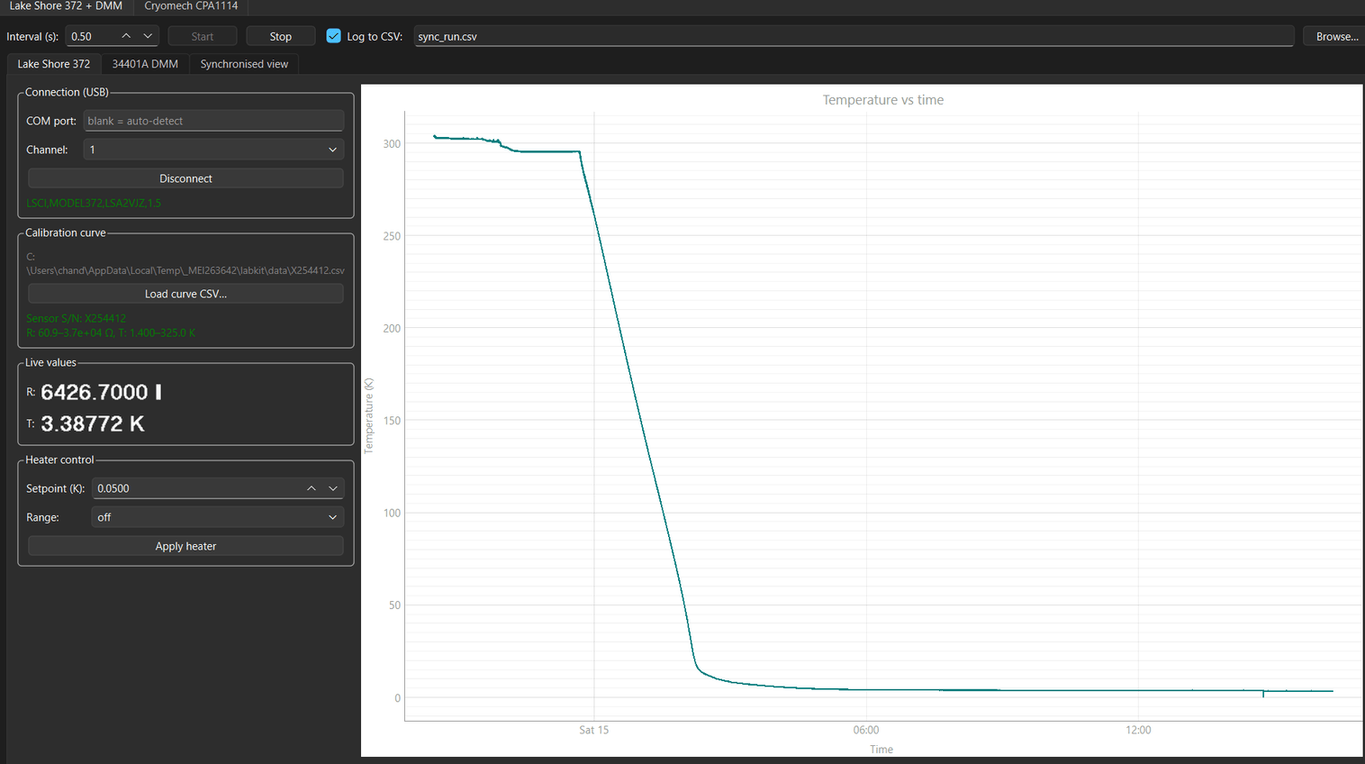
The aim is to observe anomalies continuously and actively control the thermal state.
Connected systems create system-level intelligence
Threshold-based monitoring looks at one signal at a time: if flow drops below X, raise an alarm. It is reactive, and deviations are often detected only after they are obvious.
Individually, each signal may still look acceptable. Together, their changing relationships form a system signature: compressor temperature drifting, cooling-water response changing, a pressure relationship shifting, the power signature rising, the operating state evolving. Reading that pattern reveals abnormal behaviour before any single hard limit is crossed.
Once systems are connected, the value is no longer just automation. It is understanding the relationships across the entire system.
The cryogenic digital twin
A digital twin is a continuously updated representation of the cryogenic system. It fuses a physical model, operational data and intelligent models into a live model of the fridge, built on physical modelling, live sensor data and state estimation, and it provides early warning.
The twin sits alongside supervisory control (SCADA, EPICS, and Python-based anomaly detection) and links the cryogenic state directly to quantum performance: qubit frequency, T₁, T₂, readout fidelity and drift, and from them error rate and availability. Quantum performance then feeds back to re-optimise the cryogenic state.
Toward autonomous quantum infrastructure
The path runs from monitor to control, then understand, predict and act, ending in autonomous quantum infrastructure.
The refrigerator shouldn’t just keep the processor cold. It should become an intelligent part of the system that keeps it performing.